RESULTS
Predictable delivery is not a promise. It is a measurable operating outcome.
Konya Advisory Group helps product and technology organizations strengthen execution by clarifying ownership, exposing delivery risk earlier, improving workflow, and installing repeatable release and decision systems.
The following results reflect enterprise delivery leadership performed inside complex organizations. Organization and product details have been limited where confidentiality applies.
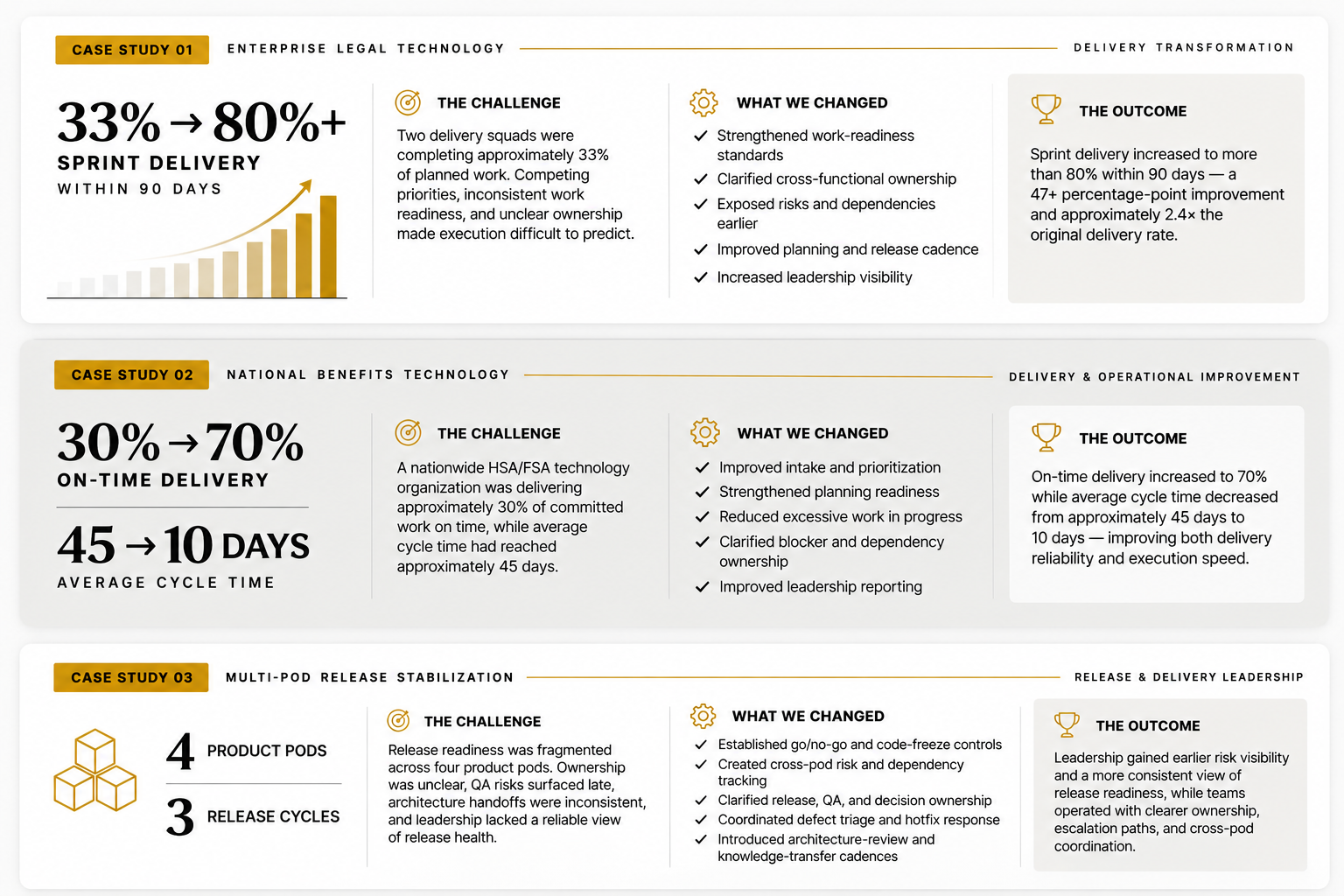
33% → 80%+ SPRINT DELIVERY Achieved within 90 days
CASE STUDY 01
ENTERPRISE LEGAL TECHNOLOGY
33% → 80%+ SPRINT DELIVERY IN 90 DAYS
THE CHALLENGE
Two delivery squads were completing approximately 33% of planned sprint work. Competing priorities, inconsistent work readiness, unclear ownership, and late-emerging dependencies made execution difficult to predict.
WHAT CHANGED
• Strengthened work-readiness standards
• Clarified ownership across functions
• Exposed risks and dependencies earlier
• Improved planning and release cadences
• Increased leadership visibility
THE RESULT
Sprint delivery increased to more than 80% within 90 days.
47+ percentage-point increase
2.4× the original delivery rate
Greater predictability across two squads
30% → 70% ON-TIME DELIVERY Improved delivery reliability
PROVEN DELIVERY RESULTS
Two enterprise delivery transformations. Measurable improvements in execution, reliability, and speed.
CASE STUDY 02
NATIONAL BENEFITS TECHNOLOGY
30% → 70% ON-TIME DELIVERY
45 → 10 DAYS AVERAGE CYCLE TIME
THE CHALLENGE
A nationwide HSA/FSA technology organization was delivering approximately 30% of committed work on time. Average cycle time had reached approximately 45 days, limiting forecasting accuracy and delaying outcomes.
WHAT CHANGED
• Improved intake and prioritization
• Strengthened planning readiness
• Reduced excessive work in progress
• Clarified blocker and dependency ownership
• Improved leadership reporting
THE RESULT
On-time delivery increased to 70%, while average cycle time decreased to 10 days.
40 percentage-point increase
Approximately 78% cycle-time reduction
Faster, more reliable execution
CASE STUDY 03
MULTI-POD RELEASE STABILIZATION
4 PRODUCT PODS
3 RELEASE CYCLES
THE CHALLENGE
Release readiness was fragmented across four product pods. Ownership was unclear, QA risks surfaced late, architecture handoffs were inconsistent, and leadership lacked one reliable view of release health.
WHAT CHANGED
• Established go/no-go and code-freeze checkpoints
• Created cross-pod risk and dependency tracking
• Clarified release, QA, and decision ownership
• Coordinated defect triage and hotfix response
• Introduced architecture-review and knowledge-transfer cadences
THE RESULT
The organization gained earlier risk visibility, clearer ownership, and stronger coordination across successive releases.
Leadership received a more consistent view of release readiness, while teams had clearer escalation paths and fewer last-minute ownership gaps.
45 → 10 DAYS CYCLE TIME Reduced by approximately 78%
WHAT LEADERS EXPERIENCE
Clearer ownership. Earlier risk visibility. Better coordinated execution.